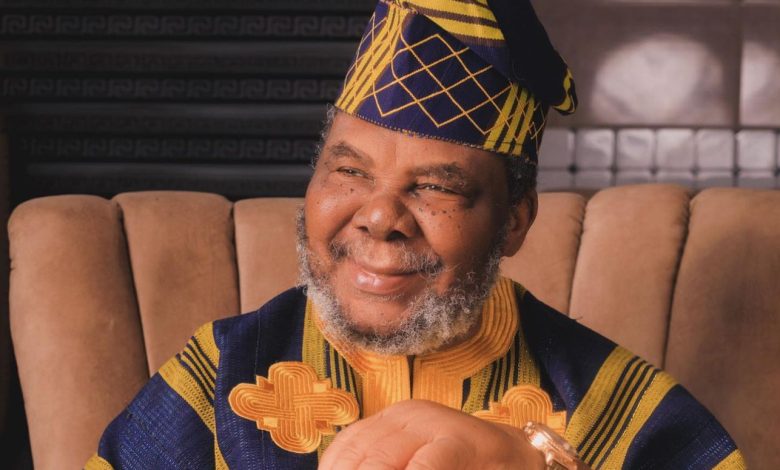
Some people die, and in mourning them, we find ourselves mourning a little part of our childhoods. Chief Edochie is one such person. For many millennials like me, any reflection on growing up in Nigeria feels incomplete without mentioning the TV series Things Fall Apart.
Something about his voice, presence, delivery, and the authority with which he inhabited his roles made watching him an experience. Long before Netflix, YouTube, and the endless entertainment options available to children today, people like Pete Edochie blessed our television screens. And what a blessing he was!
There was a time when television was a communal experience. Before everyone had a TV of their own, families or groups gathered around one set, sharing in laughter, suspense, and sometimes arguments over fictional characters’ decisions. For many of us, Pete Edochie was part of those evenings.
We were too young to appreciate the depth of his craft, yet old enough to recognise greatness when it appeared on our screens. We did not know then that we were making memories; we thought we were just watching television. Perhaps this is why his passing feels particularly personal. Growing older means gradually saying goodbye to the people who made being young so memorable.
On Wednesday, his family announced his passing at 79. They titled their announcement “An Iroko Has Fallen.” Indeed, an Iroko did fall. In our part of the world, we don’t call every tree an iroko, and we certainly don’t call every man one. The expression speaks of stature, longevity, significance, and the space a life occupies within a community.
Chief Edochie earned that description. Some actors entertain a generation; others become part of its cultural memory. Edochie belonged to the latter. His presence was so familiar that, somewhere along the way, we began to take the privilege of having him among us for granted. Nigeria has lost one of its finest actors, Africa has lost one of its distinguished cultural ambassadors, and many of us have lost a familiar presence from a period of our lives to which we sometimes wish we could return.
Chinua Achebe Gave Us Okonkwo, Pete Edochie Gave Him Life
In 1958, Chinua Achebe of blessed memory gave the world Things Fall Apart, a literary masterpiece exploring Igbo society, colonialism, identity, masculinity, and the consequences of a world undergoing profound change.
In 1987, through the Nigerian Television Authority’s adaptation of the novel, Pete Edochie gave Okonkwo a face, a voice, and a commanding presence. Achebe gave us the words; Edochie gave us a performance through which generations experienced those words. Okonkwo was a complicated man. His courage existed alongside his fears, literally struggling for space. His ambition coexisted with insecurity. His understanding of strength often prevented him from recognising the value of tenderness. He was a man whose determination never to resemble his father ultimately contributed to his own tragedy.
Most people agree it took an exceptional actor to embody these contradictions. Edochie did so without diminishing the character’s complexity. He gave audiences reasons to admire, question, fear, and critically examine Okonkwo. As an adult, I appreciate aspects of Things Fall Apart differently than I did growing up. Beyond the entertainment, the story offers important lessons about fatherhood, masculinity, power, cultural identity, and the consequences of letting the fear of appearing weak govern one’s relationships.
Perhaps this is one measure of great art: we return to it at different stages of our lives and encounter meanings we previously overlooked. Nearly four decades after that television adaptation, we are still discussing Okonkwo and the man who brought him to life on screen. What a legacy!
Before Nollywood Turned Global Phenomenon
Pete Edochie’s career path began in broadcasting in 1967, long before Nigerian films gained their present international recognition. He belonged to a generation of creative professionals who demonstrated the richness of African stories and the importance of Africans telling them.
Through productions such as Things Fall Apart, Igodo, Rituals, Billionaire’s Club, and, more recently, Lionheart, he remained relevant across successive generations of Nigerian filmmaking. He played kings, fathers, traditional rulers, elders, and men whose decisions shaped the lives of everyone around them.
Sometimes we admired his characters, sometimes we disagreed with them, and sometimes we wondered whether anyone in the household would summon the courage to challenge them. And sometimes, the mere sight of Pete Edochie appearing in a scene was enough to make us anticipate a proverb—an African proverb. You knew something profound was coming!
His delivery had a quality that made even an ordinary conversation sound consequential. His measured speech, facial expressions, and deliberate pauses demonstrated an understanding of acting far beyond memorising lines.
In an industry where actors sometimes rely on volume to communicate authority, Edochie understood the power of restraint. He did not always need to raise his voice to command attention. His contribution to Nigerian entertainment earned him the national honour of Member of the Order of the Niger (MON) in 2003. But perhaps among his most meaningful honours was the affection of generations who welcomed him into their homes through their television screens.
The Man Who Made African Proverbs Popular Culture
For me, one of the most enduring features of Pete Edochie’s screen presence was his relationship with language. His delivery of African proverbs demonstrated the intellectual richness of indigenous storytelling. They had humour, philosophy, and keen observations about human behaviour, leadership, relationships, patience, pride, and foolishness.
Even younger generations who never watched the original television adaptation of Things Fall Apart encountered Pete Edochie through film clips, memes, and viral social media posts. Few actors remain culturally recognisable across such different generations and media formats. His work reminds us of something we must never take for granted: Africa has never lacked stories worth telling.
Our languages contain sophisticated ways of understanding the world; our oral traditions preserve knowledge across generations, and our communities have histories and experiences that deserve serious artistic and intellectual attention. Edochie’s performances helped bring these traditions into popular entertainment. He demonstrated why African stories deserve to occupy our screens without apology.
The Humanity Behind His Greatness
Only last month, Chief Pete Edochie visited his ailing Ghanaian colleague, Emmanuel Armah, offering prayers and financial support. What makes this gesture particularly moving is that Edochie was also facing significant health challenges at the time.
He was struggling to walk, yet he made time to visit someone else who was suffering. There is something beautiful about remembering another person’s pain while carrying your own. We often celebrate great actors for their ability to portray humanity on screen; perhaps we should pay equal attention to the humanity they demonstrate when the cameras are no longer rolling. That visit deserves a place in our remembrance of Ebube Dike.
Let Us Preserve What They Built
As we celebrate the life of Pete Edochie, I hope we also reflect on our responsibility towards the cultural heritage his generation helped establish. Where are the original recordings of our earliest television productions? Are we adequately preserving the works of the men and women who laid the foundations of Nigerian broadcasting and filmmaking?
Will future generations have reliable access to these productions? Are we documenting the experiences of our veteran actors while they are still with us? Nigeria needs intentional investment in film restoration, digital archives, oral histories, and upholding indigenous languages through creative expression. Our schools and universities should also recognise the educational value of Nigerian cinema.
Productions such as Things Fall Apart provide opportunities to examine literature, history, colonialism, gender, family relationships, and cultural transformation. There is much to learn from the works our creative pioneers have left behind. And while we honour those who have departed, let us remember those who are still with us. Let us celebrate them while they are alive to receive our appreciation, protect their intellectual property, support their well-being, document their experiences, and create opportunities for younger artists to learn from them. Preserving cultural heritage requires more than nostalgia—it requires deliberate action.
Before Our Screens, He Belonged to a Family
Whenever someone of Pete Edochie’s stature dies, the public naturally reflects on the contributions they made to society. But behind the actor whom millions admired was a man whose family knew him in ways we never did. Before he was our beloved Okonkwo, before he became a household name, and beyond the celebrated figure we called Ebube Dike, he was a husband, a father, a relative, and a friend.
We mourn the loss of an actor whose work enriched our lives; his family mourns the loss of a person with whom they shared their lives. There is a difference, and we must respect it.
To his dearly beloved wife, Barr. Josephine Edochie, his children, grandchildren, relatives, and friends, may the Almighty God grant you comfort and the fortitude to bear this irreparable loss.
May the memories of the years you shared bring you some measure of peace, and may the affection expressed by millions remind you how deeply his life and work touched others.
Adieu, Ebube Dike
Seventy-nine years of life. Decades of artistic expression. Generations of audiences. What a privilege it was to witness your craft! Thank you for the characters you brought to life, for the laughter, the suspense, the proverbs, and the memories. Thank you for making African stories a familiar and cherished part of our childhoods. Thank you for blessing our screens.
Achebe titled his masterpiece Things Fall Apart. Today, as we bid farewell to the man who gave his most celebrated character life on television, I find comfort in the knowledge that although human life is finite, the beauty we create during our time on earth often outlives us. There is something profoundly beautiful about living a life whose work becomes part of other people’s fondest memories.
Chief Pete Edochie did precisely that.
Television screens will continue to show his films. Younger generations will encounter his performances. His voice will remain familiar, and his contribution to African storytelling will endure. One day, a child who was not alive when Pete Edochie walked this earth will sit before a screen and watch him bring a character to life. That child will hear his voice, encounter his proverbs, and perhaps ask who this extraordinary man was.
And someone will have the privilege of saying, “That was Pete Edochie. We grew up watching him.” What a beautiful thing it is to leave behind something of yourself for people you will never meet. For us millennials, this may be one of the bittersweet realities of growing older: the people who populated our childhoods are gradually becoming the people whose stories we must tell our children.
And so, the responsibility of remembering now belongs to us. Achebe gave us Okonkwo; Edochie gave us a living memory of him. History has entrusted us with the responsibility of preserving both. Indeed, an Iroko has fallen. Jee ọma, Ebube Dike. Go well, great one.
May your dearly beloved wife, family, and friends be comforted. May the Almighty God grant your soul eternal rest.
—–
Ukoh, a PhD student at Columbia University School of Social Work and co-author of Built By The Ancestors, contributed this article from the United States.