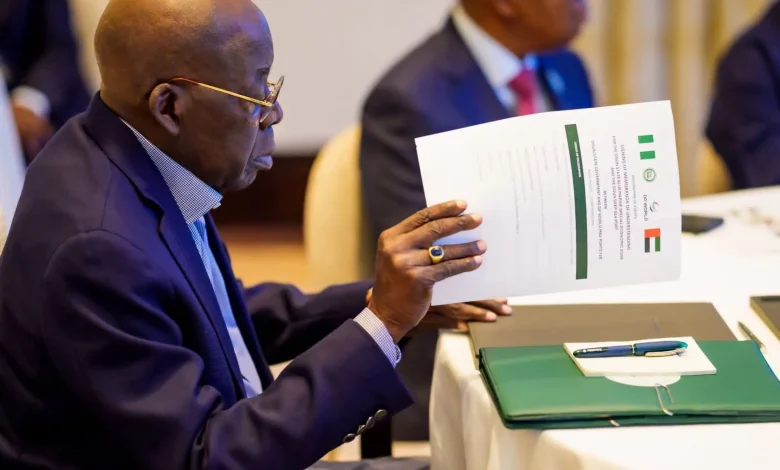
President Bola Tinubu has welcomed the World Bank’s latest assessment of Nigeria’s economy, citing its findings on economic growth and poverty stabilisation as evidence that his administration’s economic reforms are beginning to yield results.
The President’s position was contained in a statement issued on Sunday by his Special Adviser on Information and Strategy, Bayo Onanuga, following the release of the World Bank’s October 2026 Nigeria Development Update, titled *Beyond the Federal Purse: How Higher Revenues Reshaped State Priorities
According to the report, Nigeria’s real Gross Domestic Product grew by 4.2 per cent in the first half of 2026, compared with 3.9 per cent recorded during the corresponding period in 2025.
The World Bank attributed the growth largely to the services sector, alongside a stronger contribution from agriculture, noting that the improved economic performance helped stabilise the poverty rate for the first time since 2019.
Tinubu said the findings demonstrated that the government’s economic policies, including the removal of petrol subsidies, unification of the foreign exchange market and strengthened fiscal discipline, were helping to stabilise the economy, increase public revenues and create additional resources for development.
The President also welcomed the report’s assessment of state government finances, highlighting improvements in internally generated revenue and spending on economic infrastructure.
According to the World Bank, increased revenues have created opportunities for state governments to invest in critical sectors, including transportation, agriculture, energy and housing. The report also examined changes in states’ spending priorities and the need to ensure that additional public resources translate into improved services and development outcomes. ([World Bank][2])
The President, however, acknowledged that more work remained to ensure that economic gains translated into tangible improvements in the living conditions of Nigerians.
He identified lower food prices and the creation of decent jobs for young people as priorities requiring sustained attention.
The World Bank has similarly stressed that stronger economic growth alone will not be sufficient to achieve substantial poverty reduction unless it generates productive employment, raises household incomes and improves living standards.
Its October update called for faster and more inclusive growth, alongside more effective public spending and improved service delivery by state governments.
The report comes amid continued public concern over the cost of living, with households still facing pressure from food prices, transport expenses and other essential costs.
While the stabilisation of the poverty rate represents a change from previous trends, it does not mean that poverty has been eliminated or that living conditions have improved for every household.
The World Bank’s assessment points to the need for governments at all levels to ensure that stronger revenues and economic expansion produce measurable benefits for ordinary citizens.
Tinubu urged state governments to use their increased revenues prudently, emphasising the importance of directing public resources towards infrastructure, social services and initiatives capable of improving livelihoods.
The administration has maintained that its economic reforms are intended to restore macroeconomic stability and establish a foundation for sustainable growth.
The latest World Bank report, however, underscores that the next phase will depend on translating these gains into more jobs, higher purchasing power and improved access to essential services.
For Nigeria, the central challenge remains ensuring that economic growth is not measured solely by national output but also by its impact on the daily lives of citizens.