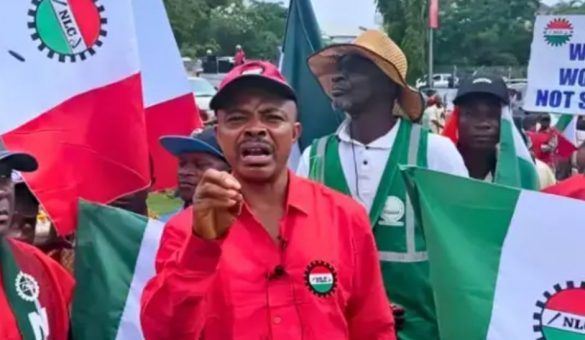
The Nigeria Labour Congress (NLC) has blasted its sister central labour organisation, the Trade Union Congress (TUC) of Nigeria, for rejecting the negotiated N70,000 transport allowance for workers, describing the relief as a significant intervention to cushion the effects of rising petrol prices and the escalating cost of living.
NLC President Joe Ajaero also challenged the TUC to negotiate better benefits for its members rather than criticise an agreement it did not participate in negotiating. This comes as the Nigeria Employers’ Consultative Association (NECA) warned that organised private-sector employers cannot be bound by minimum wage agreements reached between the Federal Government and organised labour without their participation and concurrence, insisting that employers must have an equal voice in the negotiation process.
Speaking on Channels Television yesterday, Ajaero said: “Nigerian workers were suffering; no intervention, nothing, and we have pushed with the threat of strike. We almost went on strike to get something, and then we got this.” Describing the agreement as a landmark achievement, Ajaero said: “Between now and the next six months, this is a landmark achievement,” insisting that workers must not be left worse off when the allowance expires.
On the disagreement with the TUC, Ajaero expressed surprise at its criticism, saying “The agreement was not signed by TUC, and you don’t kick against something that you didn’t negotiate. My appeal is that they (TUC) should go and ask for something higher. Let them ask for one million naira if they want. Is it better that they don’t get anything?”
Ajaero maintained that the intervention could serve as a benchmark for further negotiations involving workers across different employment categories. He warned that the six-month allowance must not expire without a new minimum wage arrangement that reflects prevailing economic realities. He argued that future wage negotiations must consider rising transportation costs, food prices, housing and other necessities.
“We have to find a way out of it. It is not in favour of government to now stop paying and then there is no new minimum wage and there is nothing new,” he said. Efforts to get the TUC to respond to Ajaero’s latest position were unsuccessful. The TUC Secretary-General, Nuhu Toro, answered his call but said he was driving and promised to call back as soon as he arrived at his destination. However, he had yet to do so as of the time of filing this report. Subsequent calls to his phone went unanswered.
Meanwhile, NECA has warned that organised private-sector employers cannot be bound by minimum wage agreements reached between the Federal Government and organised labour without their participation and concurrence. NECA in its statement said it acknowledges the ongoing engagements on the National Minimum Wage and recognises concerns regarding workers’ welfare and rising cost of living. “However, NECA strongly emphasises that the determination of the National Minimum Wage is fundamentally a Tripartite process that must involve Government, Employers and Workers as equal Social Partners.”
It cited International Labour Organisation (ILO) instruments, including Convention No. 131 and Recommendation No. 135, on meaningful consultation. “While NECA respects the right of Government and Organised Labour to hold bilateral discussions, such engagements cannot substitute for the statutory tripartite process.
Organised private-sector employers cannot be deemed parties to, or contractually bound by, agreements reached without their participation and concurrence.” NECA said it is not opposed to review of the minimum wage but insists the process must be inclusive, transparent and evidence-based.
The NLC has defended the six-month N70,000 transport allowance as a landmark intervention secured under strike threat. It has told the TUC to negotiate higher terms rather than reject an agreement it did not sign. NECA has stated that private-sector employers cannot be bound by bilateral deals without their participation. The TUC had not responded by the time of filing.